
So, who was Rochambeau anyway?
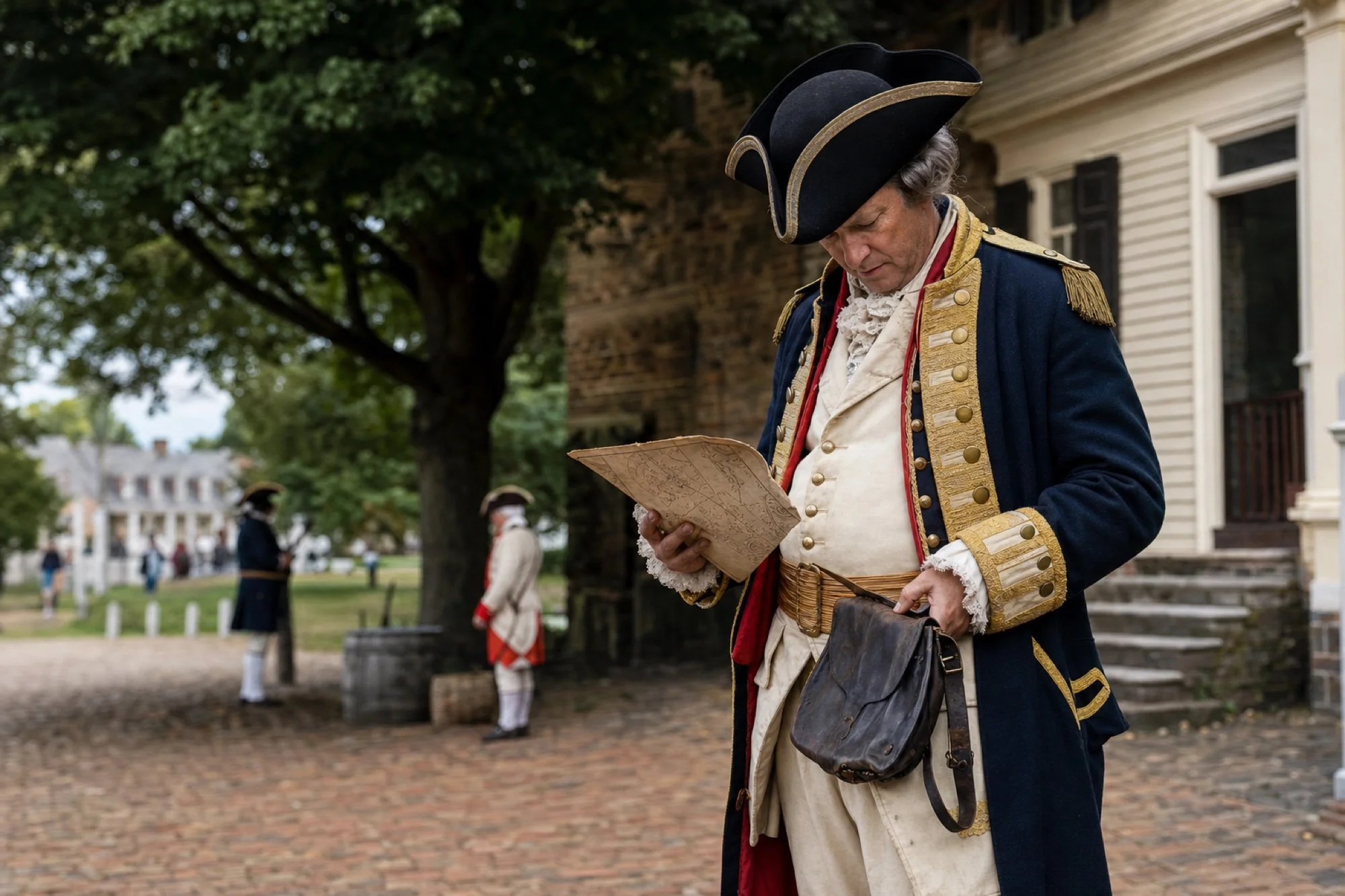
Jean-Baptiste Donatien de Vimeur, Comte de Rochambeau (1725–1807), was a French nobleman and career general. He commanded the army King Louis XVI sent to support the United States, and he fought beside George Washington and the Continental Army in the 1781 Yorktown campaign that forced Cornwallis to surrender. Many Americans know Lafayette. Fewer know the man who marched a French army from Rhode Island to Virginia, through Williamsburg, which is why a 1954 roadside motel on Capitol Landing Road still carries his name.
Key takeaways
Here is the short version, for anyone reading this on a phone in a Yorktown parking lot.
- Rochambeau (1725–1807) was a French general and count who commanded the expédition particulière, France's army sent to aid the American Revolution.
- He landed at Newport, Rhode Island, in July 1780 with about 5,500 French troops, according to the National Park Service.
- Under his government's instructions, he accepted George Washington's overall command, and that arrangement kept the Franco-American alliance working.
- French land forces, Admiral de Grasse's fleet, and the Continental Army trapped Cornwallis at Yorktown, and he surrendered on October 19, 1781.
- The Allied armies gathered at Williamsburg before the march to Yorktown, and French forces wintered here afterward.
Rochambeau at a glance
These are the core facts, drawn from the National Park Service, George Washington's Mount Vernon, and the American Revolution Institute.
| Fact | Detail |
|---|---|
| Full name | Jean-Baptiste Donatien de Vimeur, Comte de Rochambeau |
| Born | July 1, 1725, Vendôme, France |
| Died | 1807, at his estate at Thoré-la-Rochette, near Vendôme |
| Nationality | French |
| Rank in America | Lieutenant general |
| Best known for | Commanding the French expeditionary army in the American Revolutionary War |
| Key campaign | 1781 Yorktown campaign and the Siege of Yorktown |
| Highest rank | Marshal of France, 1791 |
| Earlier wars | War of the Austrian Succession; Seven Years' War |
Who was Rochambeau before he came to America?
When Rochambeau reached Rhode Island he was 55 and had about 37 years of service behind him. He was a methodical professional rather than a dashing young volunteer, and that difference shaped everything he did in America.
A count, a general, and very nearly a priest
He was the third son of an old aristocratic family, so his parents set him on a path toward the church. That changed when his older brother died, and he entered the army as a teenager (NPS). "Comte" was his hereditary title. Soldiering was his profession.
Forty years of European soldiering
He first saw combat in the War of the Austrian Succession (1740–48). At Lauffeld in 1747 he was wounded by grapeshot while leading a cavalry charge, and that same year, at 22, he became a colonel with his own regiment. In the Seven Years' War he served in the 1756 Minorca campaign and was wounded again after his promotion to general (Mount Vernon). The National Park Service calls him "a veteran of 14 sieges in Europe" (NPS Yorktown). Siege work was exactly what Yorktown would require.
What did Rochambeau command in the American Revolution?
In March 1780, King Louis XVI selected Rochambeau to command France's army in North America, "with orders to cooperate with General Washington." He commanded the French army on land, not the French navy, and that distinction matters more than most summaries admit.
What was the Expédition Particulière?
The French government called the force the expédition particulière, which means "special expedition." The National Park Service and Mount Vernon both put its strength at about 5,500 troops. The American Revolution Institute gives about 5,800. The army was not entirely French-born. Most soldiers in the Royal Deux-Ponts Regiment came from German-speaking regions.
Why did the French army wait a year in Newport, Rhode Island?
The convoy was first bound for Charleston. A captured privateer brought word that the city had fallen, so the fleet turned north and the troops came ashore at Newport in mid-July 1780. British warships soon cruised off Newport, and on July 22 Rochambeau wrote Washington that they meant to intercept France's second division (Founders Online). That second division never arrived, because the British blockaded it at Brest. Without reinforcements or naval superiority, the army stayed put.
Army vs. fleet: Rochambeau and de Grasse held separate commands
Rochambeau commanded the French army on land. Admiral de Grasse commanded the French fleet that sailed into the Chesapeake. Yorktown needed both commands.
How did Rochambeau and George Washington work together?
Rochambeau led the French army and Washington led the Continental Army. Rochambeau had far more professional experience, but the French government instructed him to place his army under Washington's overall command, and "he respected that arrangement" (NPS).
Did Rochambeau outrank George Washington?
Rochambeau had more seniority and more experience, but he did not hold command over Washington. As the National Park Service puts it, "Rochambeau commanded the French forces, while Washington commanded the combined American and French army." Seniority and experience were one question. Who directed the joint campaign was another.
Why the partnership held
Washington first relied on Lafayette to translate. Rochambeau later asked to write to Washington directly, which helped the two men work together. In May 1781 they met at Wethersfield, Connecticut, roughly halfway between their headquarters. The conference committed the Allies to an operation against New York, and Rochambeau left de Grasse the option of joining either a New York or a Virginia campaign. The NPS cautions that it is "too much to say" Wethersfield laid the plans for Yorktown (NPS).
What was Rochambeau's role at Yorktown?
Rochambeau brought French regular troops and deep siege experience south to Virginia. His army fought alongside Washington's Continental Army while de Grasse's fleet held the Chesapeake. The month-long siege ended with the surrender of Cornwallis's roughly 8,000 troops on October 19, 1781.
Why the armies turned south to Virginia
The plan was still New York until August 14, 1781. That day Rochambeau learned that de Grasse would sail for the Chesapeake with troops aboard and could stay only until October 15. Cornwallis was entrenched at Yorktown, within reach of that fleet, and Washington acted within days. According to Mount Vernon, about 12,000 Allied soldiers moved to Virginia, along a route the NPS now traces as a 680-mile trail from Newport to Yorktown.
Who did what in the Yorktown campaign
No single commander won Yorktown. Each of these figures played a different part.
| Figure | Role in 1781 | Why it mattered |
|---|---|---|
| George Washington | Commander of the Continental Army and the combined Allied force on land | Directed the joint campaign |
| Comte de Rochambeau | Commander of the French army | Brought French regulars and the experience of 14 European sieges |
| Admiral de Grasse | Commander of the French fleet in the Chesapeake | Won the Battle of the Capes on September 5, 1781, and kept British naval relief from reaching Cornwallis (NPS) |
| Marquis de Lafayette | Continental Army major general in Virginia from March 1781 | Shadowed and constrained a larger British force and urged Washington south |
| Charles Cornwallis | British commander at Yorktown | Besieged; surrendered October 19, 1781 |
Did Yorktown end the Revolutionary War?
Yorktown effectively ended major land fighting in America. The war formally ended with the Treaty of Paris in 1783. The surrender ceremony reflected the alliance. Cornwallis sent Brigadier General Charles O'Hara in his place, and O'Hara first approached Rochambeau, who directed him to Washington. Washington in turn sent him to Major General Benjamin Lincoln, who accepted the sword and returned it (NPS).
Rochambeau, Williamsburg, and the road to Yorktown
Most biographies skip from New York straight to the siege lines. The weeks in between, and the winter afterward, happened in Williamsburg, which had been Virginia's colonial capital from 1699 to 1780.
When the Allied armies gathered in Williamsburg
Lafayette entered Williamsburg on September 4, 1781, and French troops under Saint-Simon arrived in early September. Washington and Rochambeau came ahead of their armies. Washington stayed at George Wythe's house, and Rochambeau lodged with Betty Randolph. Troops from New York landed at Burwell's Landing, College Landing, and Jamestown and camped near the Capitol. At 5 a.m. on September 28, the reorganized army marched for Yorktown (Journal of the American Revolution).
After the surrender, two French regiments wintered in Williamsburg. Rochambeau and his staff lived in the Wythe House on Palace Green, and the College of William & Mary served as a French hospital. The French marched north on July 1, 1782.
The 30-second version for kids: France sent a general with an army to help George Washington. They marched from Rhode Island to Virginia, gathered in Williamsburg, and joined American soldiers and a French fleet to trap the British at Yorktown.
Where to follow Rochambeau's story near Williamsburg today
You can trace much of the 1781 story from Capitol Landing Road.
- The Rochambeau Roadside Inn. The namesake story starts here, at 929 Capitol Landing Road, about 1.4 km from the Colonial Williamsburg Visitor Center. Take the complimentary bikes on the ten-minute ride into the Historic Area, or drive to Yorktown from free parking right outside your door. The 22 rooms include family suites and custom bunk rooms, so you can see the rooms, from the Classic Double to the family suites. In the evening, the firepits come with free firewood, and s'mores kits are sold in the lobby.
- Colonial Williamsburg Historic Area. The Wythe House, Palace Green, and the College of William & Mary all hosted the 1781–82 Allied presence.
- Yorktown Battlefield, Colonial National Historical Park. Visit the siege landscape and the sites associated with the Allied victory, including Surrender Field and the Moore House.
- Yorktown Victory Monument. Congress authorized it in 1880. One of its four base inscriptions commemorates the treaty of alliance with France (NPS).
- Washington-Rochambeau Revolutionary Route National Historic Trail. This 680-mile trail ends at Yorktown.
What happened to Rochambeau after the Revolution?
Rochambeau returned to France a hero and resumed his duties. In 1783 he became a founding member of the French Society of the Cincinnati. He was named Marshal of France in 1791 and commanded an army in 1792. During the Reign of Terror he was arrested as a "suspect" in 1794 and scheduled for execution, but the Terror ended before the sentence was carried out. He died in 1807 at his estate at Thoré-la-Rochette. His Mémoires appeared in Paris in 1809, and in 2016 his family gave the original manuscript to the Society of the Cincinnati (American Revolution Institute).
Why is Rochambeau less famous than Lafayette?
Their careers took very different shapes. Lafayette was a young volunteer holding an American commission who later returned for a famous tour. Rochambeau was a senior officer of the French crown who went home after the war.
| Rochambeau | Lafayette | |
|---|---|---|
| Age at Yorktown | 56 | 24 |
| Served in | French royal army | Continental Army, as a major general |
| Role in 1781 | Commanded the French army | Shadowed Cornwallis in Virginia before the Allies arrived |
| Later ties to the United States | Founding member of the French Society of the Cincinnati, 1783 | 13-month tour of all 24 states, 1824–25 |
Why a 1954 Williamsburg motor inn carries his name
The property was built between 1952 and 1954 and first welcomed guests as Motel Rochambeau in 1954. The Bryhn family ran it for almost 70 years. In 2024 it was bought by Williamsburg native Lyle Schiavone, with his sister Anna as Creative Director, and it opened for bookings that December. The name stayed. Near the Palace Green where Rochambeau spent the winter of 1781, it still fits. Read the story of the motel itself.
Make a weekend of the road to Yorktown
Yorktown Day falls on Monday, October 19, 2026, the 245th anniversary of the surrender. Victory Weekend runs October 16–19, with artillery firings and interpretive programs at the battlefield. A good day might look like this: ride a bike into the Historic Area in the morning, head to Surrender Field in the afternoon, and finish with drinks around the fire. Before you go, check NPS for current Colonial Parkway status, since its rehabilitation is in its final phase. For more ideas, see Williamsburg during America 250 and things to do in Williamsburg.
Frequently asked questions about Rochambeau
These are the questions guests ask most often, answered briefly. For stay details, see policies and stay questions or browse more from the Field Guide.
Was Rochambeau a real person?
Yes. Jean-Baptiste Donatien de Vimeur, Comte de Rochambeau, was a French general born in Vendôme in 1725. He commanded France's army in the American Revolution and died in 1807.
Who was the French commander in the American Revolution?
Rochambeau commanded the French army sent to North America. Admiral de Grasse commanded the French fleet in the Chesapeake campaign. Lafayette was French, but he served as a Continental Army major general.
How many French soldiers did Rochambeau bring to America?
The National Park Service and Mount Vernon both put the figure at about 5,500 troops landing at Newport in July 1780. The American Revolution Institute gives about 5,800.
Was Rochambeau at the Siege of Yorktown?
Yes. Rochambeau commanded the French army throughout the siege. At the surrender on October 19, 1781, Charles O'Hara approached him first, and Rochambeau directed him to Washington.
What does "Rochambeau" mean in slang?
"Roshambo," also spelled "ro-sham-bo," is a name for rock-paper-scissors, used mostly on the West Coast. Its earliest known use is a 1936 Oakland recreation handbook. Linguist Ben Zimmer finds no evidence connecting it to the general (Mental Floss).
What happened to General Cornwallis after he surrendered?
Cornwallis was exchanged for Henry Laurens in May 1782. He later served as Governor-General of India from 1786 to 1793 and as Lord Lieutenant of Ireland, and he died in 1805.
Where can I learn about Rochambeau near Williamsburg?
Start at the Rochambeau Roadside Inn on Capitol Landing Road. From there, visit the Wythe House on Palace Green, then Yorktown Battlefield, Surrender Field, and the Victory Monument, which are all stops tied to the 1781 campaign.